The Human Brain: Neuroscience Meet Conceptual Art

Media_httpihuffpostco_pjixe

True, the nine images selected here by Carl Schoonover are stunning, but what intrigues me more is the obvious passion for his work that is communicated in his written descriptions and stories for the images.

Elegance often begets meaning and understanding. In a fit of candor, Nobel laureate Richard Axel once pronounced that “science without enchantment is nothing!” In my new book Portraits of the Mind: Visualizing the Brain from Antiquity to the 21st Century (Abrams), I examine this special relationship, and share the images and stories I have come to love–many of which were, until now, only available to people in the field.

If only by name, ‘neuroscience’ can be off-putting. An invitation to a guided tour, of words and images depicting humanity’s emerging understanding of a key part of what makes us each who we are, is very appealing. I’m not really an example of a hard sell for books on human behavior or the brain, but nonetheless, Schoonover’s new book has been added to the top of my ‘next-trip’ list for the bookstore or library.

Food and Money: The Value Of A Dollar Translated

The Value Of A Dollar

To visualize the The Value Of A Dollar, artist Jonathan Blaustein purchased exactly one-bucks-worth of nineteen different foodstuffs, and photographed each, stripped from its packaging, on a plain white background. Blaustein explains:

I’m interested in the way photography is used to deceive. Millions, if not billions of advertising dollars are spent annually photographing food and obfuscating reality. Fast food conglomerates are certainly the worst culprits, but everywhere we see glamorized versions of what we eat.

To learn more, see the full series and his New York Times LENS Blog interview.

[Jonathan Blaustein via kottke]


These striking images remind me again of my fascination in how words can be used to deceive. The impact of marketing and advertising is based on this powerful combination of words and photography. Sadly, for food and sustainable agriculture, the power has not been used well.

Windcuts: Amazing 3D Wooden Forms from Wind Movement Data

windcuts.jpg
Windcuts [flickr.com] consists of various experiments that turn quantitative sensor data into visually compelling physical instantiations. Wind movement measurement data, such as wind direction, velocity and temperature, was used as the foundation to generate a 3D form, which was then physically drilled out of a piece of wood.

The direction of the physical line corresponds with the direction of the wind. The width and speed of movement reflects the wind speed. The temperature is mapped unto the height. The materials ‘surface plateau’ height represents zero degrees Celsius. So when the shape dips below the surface, it means the wind’s below zero degrees.

There’s something oddly compelling to me about the very idea of creating a 3D form, in wood no less, from data based on the seemingly ephemeral movement of air — also known as wind.

I see potential here for a wonderful educational tool. For those like myself, more comfortable with words than numbers in volume, these 3D forms bring to life otherwise fuzzy terms such as wind shear or turbulence. Makes me wonder if the climate change debate could have been shortened if displays like this were available for each physical effect discussed. Kudos to Information Graphics, and be sure to check out their other 3D representations.

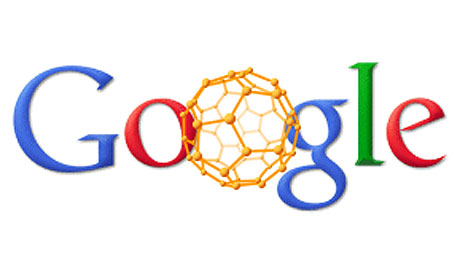
Google doodle marks buckyball anniversary

Media_httpstaticguimc_cbhjl

This interactive doodle is just a bit of mental fun from Google, yet when the Guardian (U.K.) adds a solid back story, it becomes much more. It’s hard not to think of the millions of people, who like me, may otherwise never have heard of the ‘buckyball’ or as it is formally known, the buckminsterfullerene, a ‘specially shaped molecule composed entirely of carbon.’

Granted, my life and that of many others would have proceeded quite well without this factoid, yet it strikes me there’s more at play here than doodling. Arguably, the world is suffering in many ways because too many people understand too little about science, math and technology. In many instances, these applied fields are contributing to our problems, and yet they may offer our only solutions as well. Public conversations about both the problems we face, and the opportunities for solutions, are often made more difficult by this lack of a shared basic understanding of the principles involved.

So as a technology company with access to millions of us worldwide, Google’s choice to use its platform as an elegant canvas for advancing our molecular knowledge strikes me as corporate power well used. Kudos, Google.

A Building That Teaches Through Its Landscape – UVM in The Chronicle of Higher Education

Media_httpfarm5static_nfanj

As pleased as I was to see the new Jeffords building at the University of Vermont featured in The Chronicle of Higher Education, I must confess to being somewhat disappointed by this piece. Although Dean Tom Vogelmann appears amiable and approachable in the photograph above, the remaining photos do little to convey the “functional elegance” of the exterior or interior design of the new home for plant biology, soil sciences, and life sciences at UVM. The more important omissions to my mind, however, are details on the myriad steps and design choices made to enable a large building with teaching science labs to minimize its environmental footprint and to be potentially eligible for LEED gold certification. I yearned to know more about how that was accomplished. True, the teaching landscape featured in the article is interesting, yet I’ve begun to fear we fall further behind in the battle to minimize the effects of climate change whenever we miss an opportunity to inform and educate. I expected more from this publication.

Disclosure: I currently serve on the Board of Advisors for the UVM College of Agriculture & Life Sciences.