Trending terms: Sustainable business, green business or CSR? Google Labs – Books Ngram Viewer

Media_httpngramsgoogl_hgafa

The delightful new Ngram Google Labs tool combines three of my favorite things: words, books and infographics. Here I’ve selected three terms — green biz, sustainable business and corporate social responsibility – to see which is the trending term in books over the past 50 years. Fascinating! (Who needs sudoku?) Check it out for your favorite words >> New Google Labs Ngram http://ow.ly/3r7KW

Food and Money: The Value Of A Dollar Translated

The Value Of A Dollar

To visualize the The Value Of A Dollar, artist Jonathan Blaustein purchased exactly one-bucks-worth of nineteen different foodstuffs, and photographed each, stripped from its packaging, on a plain white background. Blaustein explains:

I’m interested in the way photography is used to deceive. Millions, if not billions of advertising dollars are spent annually photographing food and obfuscating reality. Fast food conglomerates are certainly the worst culprits, but everywhere we see glamorized versions of what we eat.

To learn more, see the full series and his New York Times LENS Blog interview.

[Jonathan Blaustein via kottke]


These striking images remind me again of my fascination in how words can be used to deceive. The impact of marketing and advertising is based on this powerful combination of words and photography. Sadly, for food and sustainable agriculture, the power has not been used well.

A Building That Teaches Through Its Landscape – UVM in The Chronicle of Higher Education

Media_httpfarm5static_nfanj

As pleased as I was to see the new Jeffords building at the University of Vermont featured in The Chronicle of Higher Education, I must confess to being somewhat disappointed by this piece. Although Dean Tom Vogelmann appears amiable and approachable in the photograph above, the remaining photos do little to convey the “functional elegance” of the exterior or interior design of the new home for plant biology, soil sciences, and life sciences at UVM. The more important omissions to my mind, however, are details on the myriad steps and design choices made to enable a large building with teaching science labs to minimize its environmental footprint and to be potentially eligible for LEED gold certification. I yearned to know more about how that was accomplished. True, the teaching landscape featured in the article is interesting, yet I’ve begun to fear we fall further behind in the battle to minimize the effects of climate change whenever we miss an opportunity to inform and educate. I expected more from this publication.

Disclosure: I currently serve on the Board of Advisors for the UVM College of Agriculture & Life Sciences.

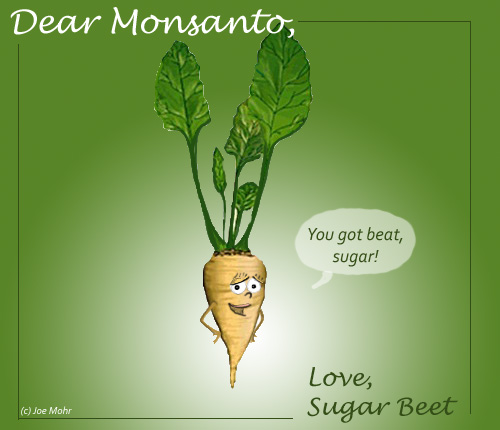
GMOs Lose a Round >> Monsanto Gets Beat–May Lose Beets (cartoon)

Media_httptwilightear_rdwip

A victory for anyone who likes healthy food, soil, and water! Monsanto’s sour plans for the sweet beet were spoiled as a federal judge banned genetically modified sugar beets.

This is great news and hopefully a large step forward to getting food production back on a less toxic track.

For a long time now, I’ve harbored the desire to develop my editorial cartoon inner self. This timely take on the court ruling against Monsanto’s genetically modified sugar beets is a perfect example of why.

Designing Regenerative Food Systems: Worldchanging

Media_httpwwwworldcha_hwjer

This post on urban food systems using permaculture is part of Worldchanging’s series on the Living Future 2010 conference. Permaculture is one of those ideas that fascinates me. It simply resonates with my practical self that lightly managing the relationship between symbiotic living organisms to create food is a smart and sustainable concept. Why is it we don’t hear more about this?